Nîmes sits in the south of France between Montpellier and Avignon, and it contains some of the best-preserved Roman monuments anywhere in the world outside of Rome itself. Most visitors to the region head straight to Provence or the Camargue and treat Nîmes as a passing stop, which means they miss one of the genuinely great historic cities in France.
This walking guide to Nîmes covers everything you need to explore the city properly on foot, from the thundering scale of the Roman arena to the quiet garden terraces above the old town, with practical information on timing, tickets, and the best places to stop along the way. If you give Nîmes a proper day rather than a passing hour, it will surprise you consistently.
Why Explore Nîmes on Foot
 Historic Nîmes is a compact city, and that compactness is one of its greatest advantages for visitors. The main Roman sites sit within a 20-minute walk of each other, and the streets that connect them are worth walking slowly rather than cutting through by taxi or tourist train. The old town fabric between the monuments tells as much of the story as the monuments themselves, with medieval street patterns laid over Roman foundations that you can trace as you move through the city.
Walking also gives you the flexibility to stop at a café, wander into a covered market, or duck into a hidden square whenever something catches your eye. No other Roman city of this scale in France is quite as rewarding to cover on foot, and this walking guide to Nîmes is built around making the most of that quality.
Practical Information Before You Start
- Best season and weather: April through June and September through October offer the most comfortable walking temperatures, generally between 18°C and 26°C, with lower crowd levels than peak summer. July and August bring intense heat and larger crowds, particularly at the arena. Winter visits are quiet and mild by northern European standards, though some sites reduce their opening hours.
- Where to start the walk: The Nîmes Arena at Place des Arènes is the natural starting point. It sits in the centre of the city, is immediately recognisable, and orientates you toward everything else on the route. Most visitors arriving by train will find it a 10-minute walk from the station.
- What to wear and bring: Comfortable flat shoes are essential. Several sections of the route cross old cobblestones that become slippery after rain. Bring a water bottle, sunscreen from April onwards, and a light layer for the Jardins de la Fontaine in the early morning or evening when the temperature drops.
- Tickets and money-saving tips for 2026: The Nîmes Pass covers entry to the arena, the Maison Carrée, and the Tour Magne for around €13 per adult, representing a meaningful saving against individual entry prices. Buy it online in advance or at the first monument you visit. The Jardins de la Fontaine are free to enter. Pont du Gard requires a separate entry fee of around €10 per vehicle or €4 for pedestrians and cyclists.
The Ultimate Self-Guided Walking Route
Stop 1: Les Arènes, the Nîmes Roman Arena
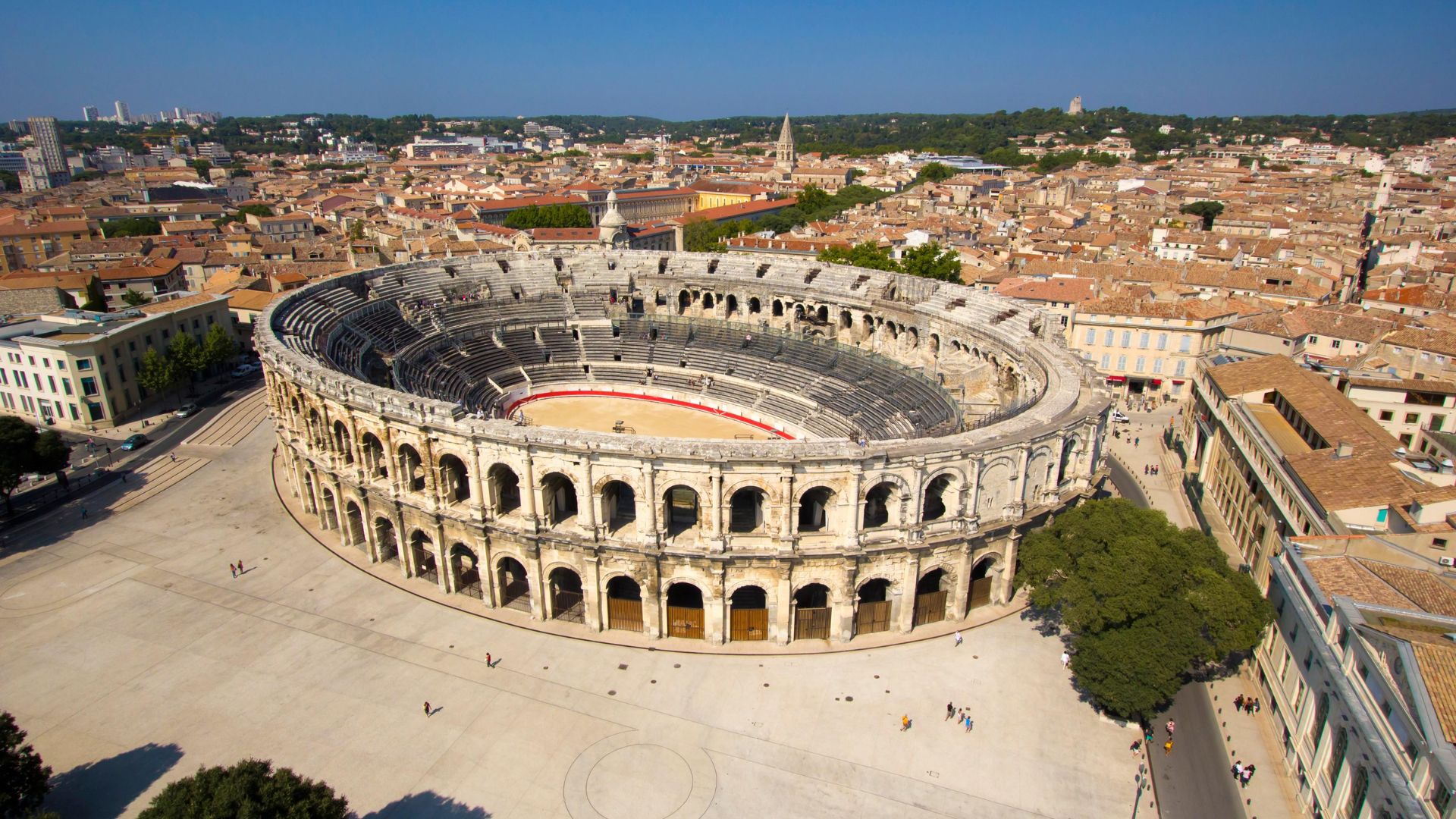 The Roman arena at Nîmes is the starting point for any walking guide to Nîmes, and rightly so. Built around 70 AD during the reign of the Flavian emperors, it is one of the most completely intact Roman amphitheatres surviving anywhere in the world. The outer façade stands two storeys high with 60 arched bays running around its full oval circumference, and from street level the scale is genuinely striking before you even step inside.
Inside, the tiered seating that once held 24,000 spectators is still largely intact, and walking up through the vaulted corridors to the upper terraces gives you a clear view of the arena floor and the surrounding rooftops of historic Nîmes beyond the walls. The site museum within the arena covers gladiatorial combat, Roman civic life, and the building’s later history as a fortified town inhabited by several hundred residents through the medieval period.
- Photo spots: The south-facing exterior at mid-morning gives you clean light on the full façade. From the upper seating tier, the view across the arena floor and out over the city makes for a strong wide-angle shot.
- Nearby: Café de la Bourse on the adjacent boulevard is a reliable spot for a coffee before you set off. Give yourself 60 to 90 minutes inside the arena before moving on.
- Walking time to next stop: 5 minutes on foot heading northwest on Boulevard Victor Hugo.
Stop 2: Maison Carrée, the Ancient Temple
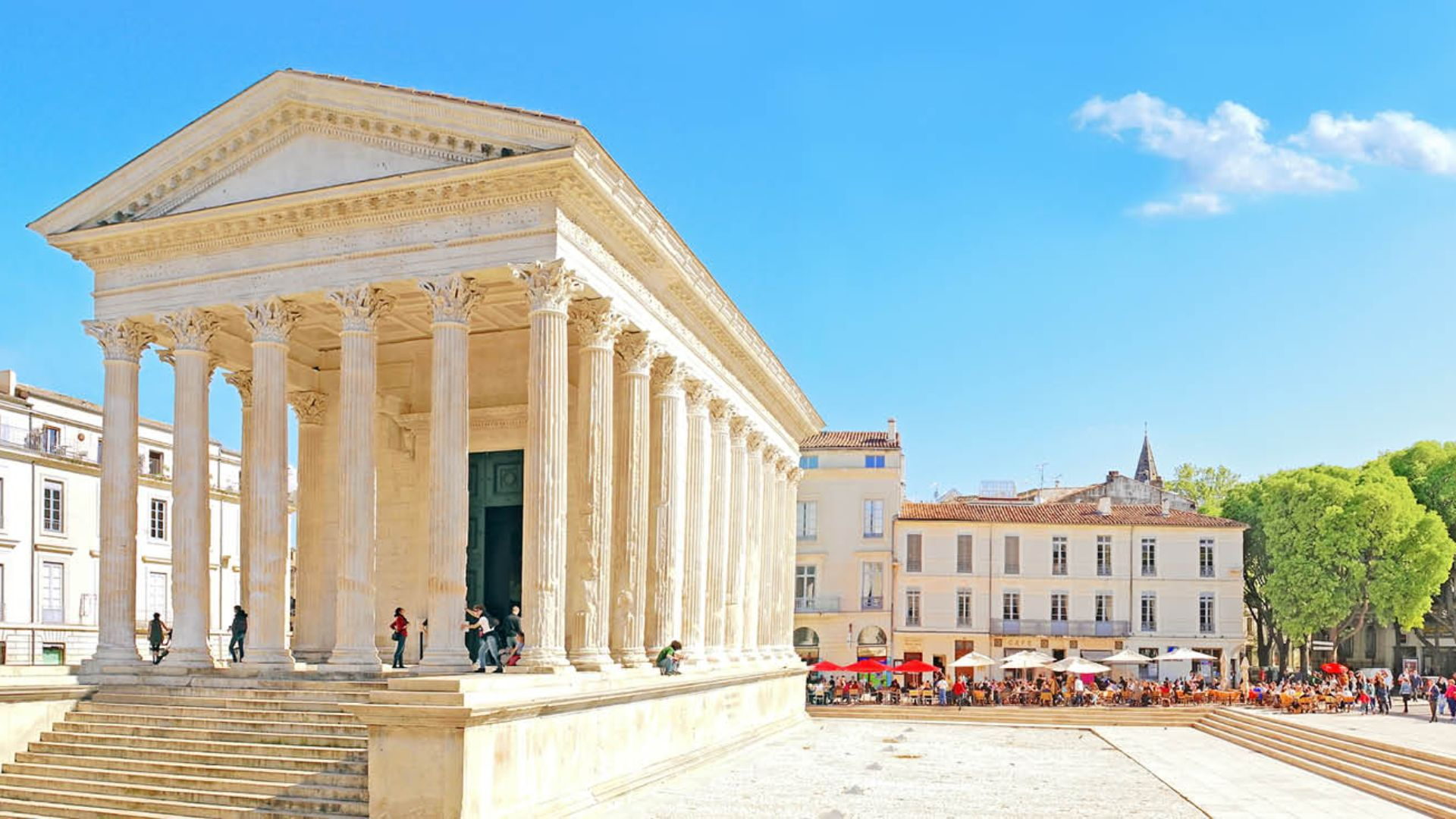
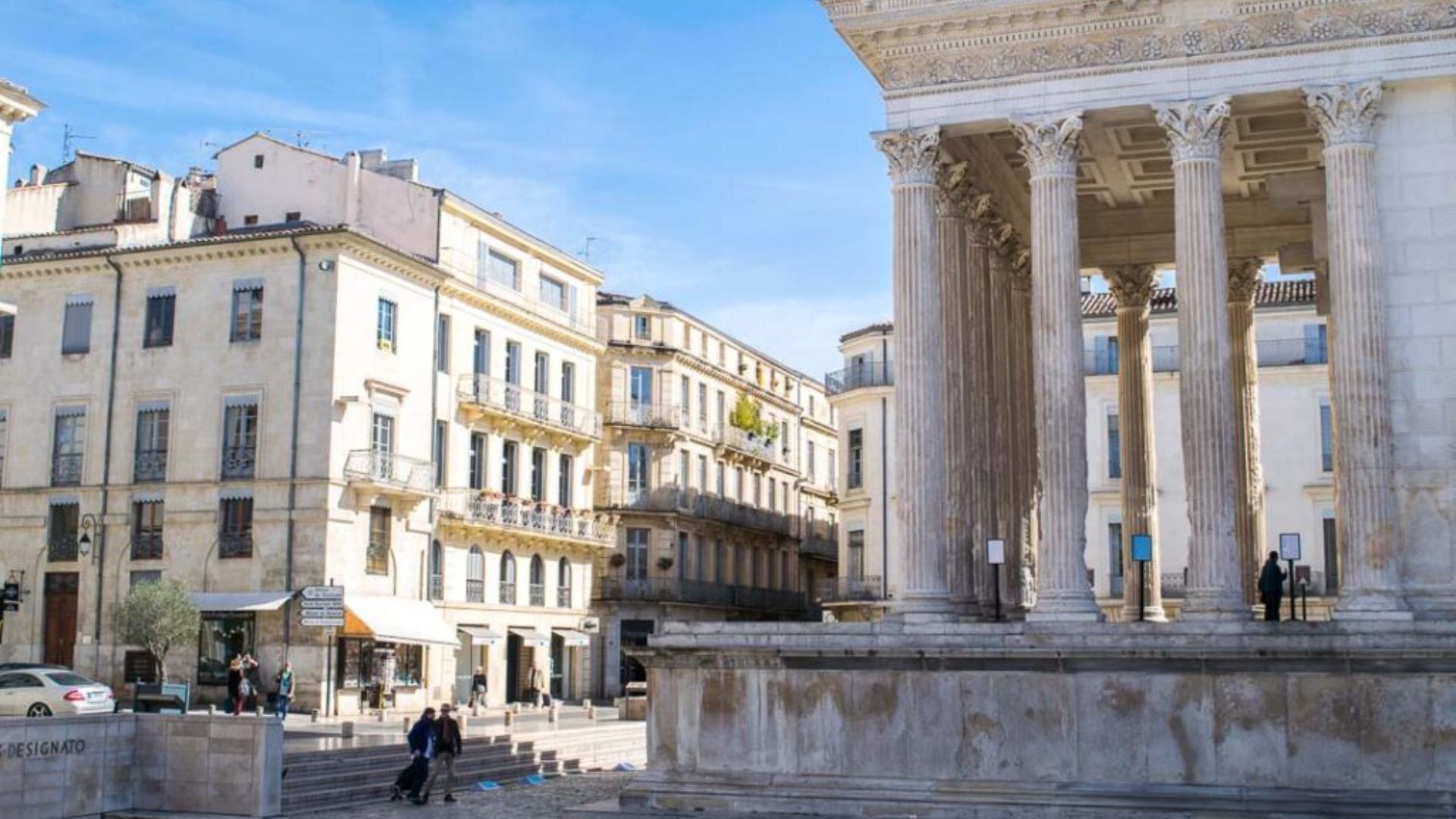
 The Maison Carrée is one of the best-preserved Roman temples in existence, and standing in front of it for the first time is one of those moments in historic Nîmes that genuinely registers. Built around 4 to 7 AD and dedicated to the grandsons of Augustus, the temple sits on a raised podium with a full colonnade of Corinthian columns running around its exterior. The proportions are nearly perfect, and the carved frieze along the entablature retains considerable detail after two thousand years.
The interior now functions as a projection theatre showing a short film on the city’s Roman history, which provides useful context for the rest of the walk. The surrounding square, Esplanade Charles de Gaulle, offers a clean view of the façade from a comfortable distance that frames the temple well against the sky.
- Photo spots: Position yourself at the base of the approach steps and shoot upward along the colonnade for a dramatic perspective shot. Early morning before the cafés open gives you the square largely to yourself.
- Walking time to next stop: 5 to 8 minutes northeast toward Place du Forum.
Stop 3: Place du Forum and the Medieval Streets
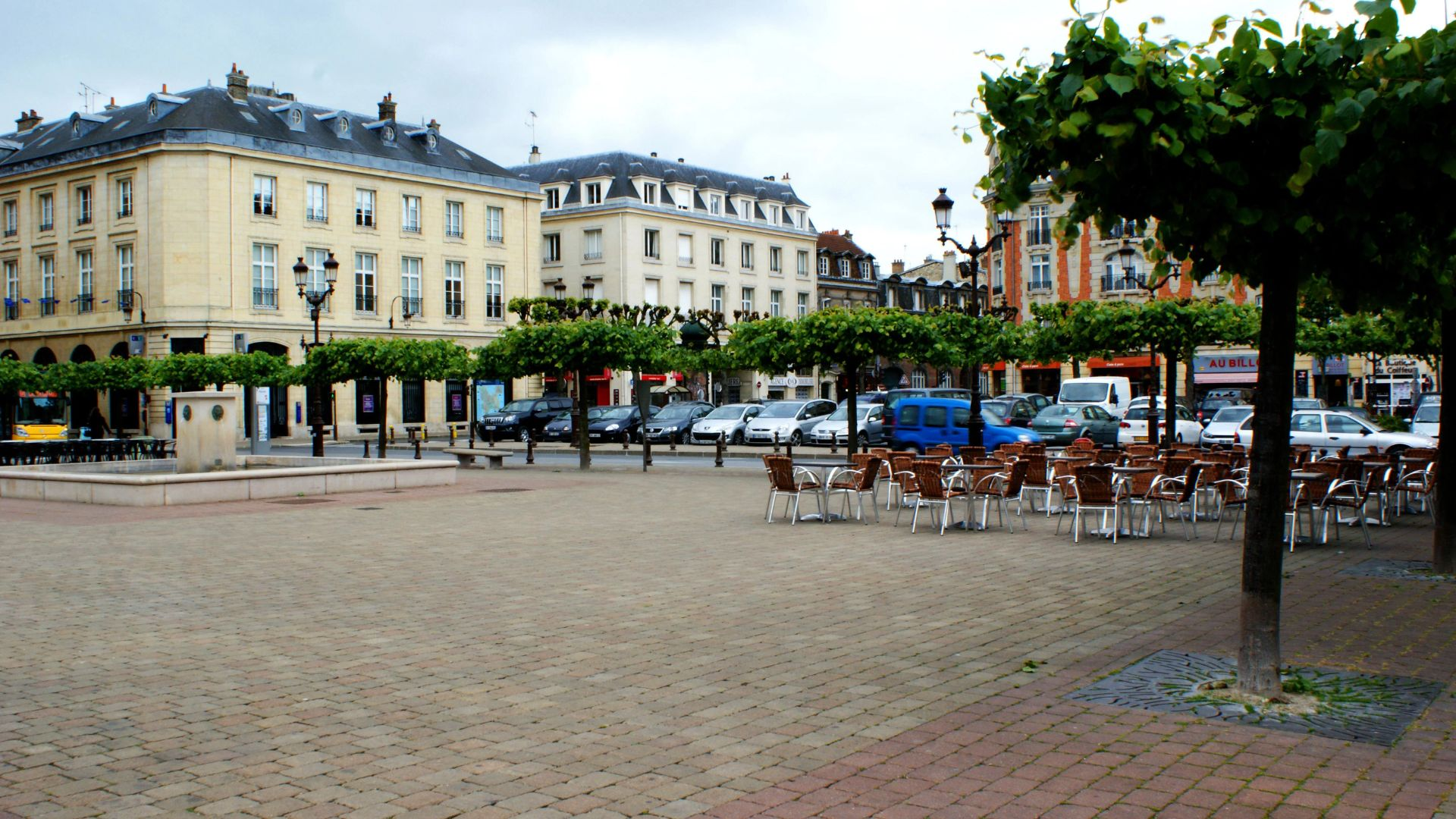 Place du Forum occupies the site of the ancient Roman forum at the heart of historic Nîmes, and today it functions as the social centre of the old town. The square is lined with cafés and brasseries that stay busy from breakfast through late evening, and two Corinthian columns embedded into the wall of a later building on the north side are a quiet reminder of what stood here before the medieval city built over it.
The real reward at this stop is leaving the square and walking the surrounding medieval streets rather than staying on the main pedestrian axis. Rue de l’Aspic, Rue des Marchands, and the lanes connecting them toward Rue du Grand Couvent are lined with 17th and 18th-century townhouses, small artisan workshops, and independent food shops that give you a genuine sense of the city beyond its monuments.
- Hidden square: Cours Nemausus, a few minutes north of Place du Forum, is a contemporary public space that most visitors walk past without stopping. It connects old Roman street lines to a modern urban design project and is worth a brief detour for the architectural contrast.
- Walking time to next stop: 15 to 20 minutes northwest toward the Jardins de la Fontaine.
Stop 4: Jardins de la Fontaine and the Temple of Diana
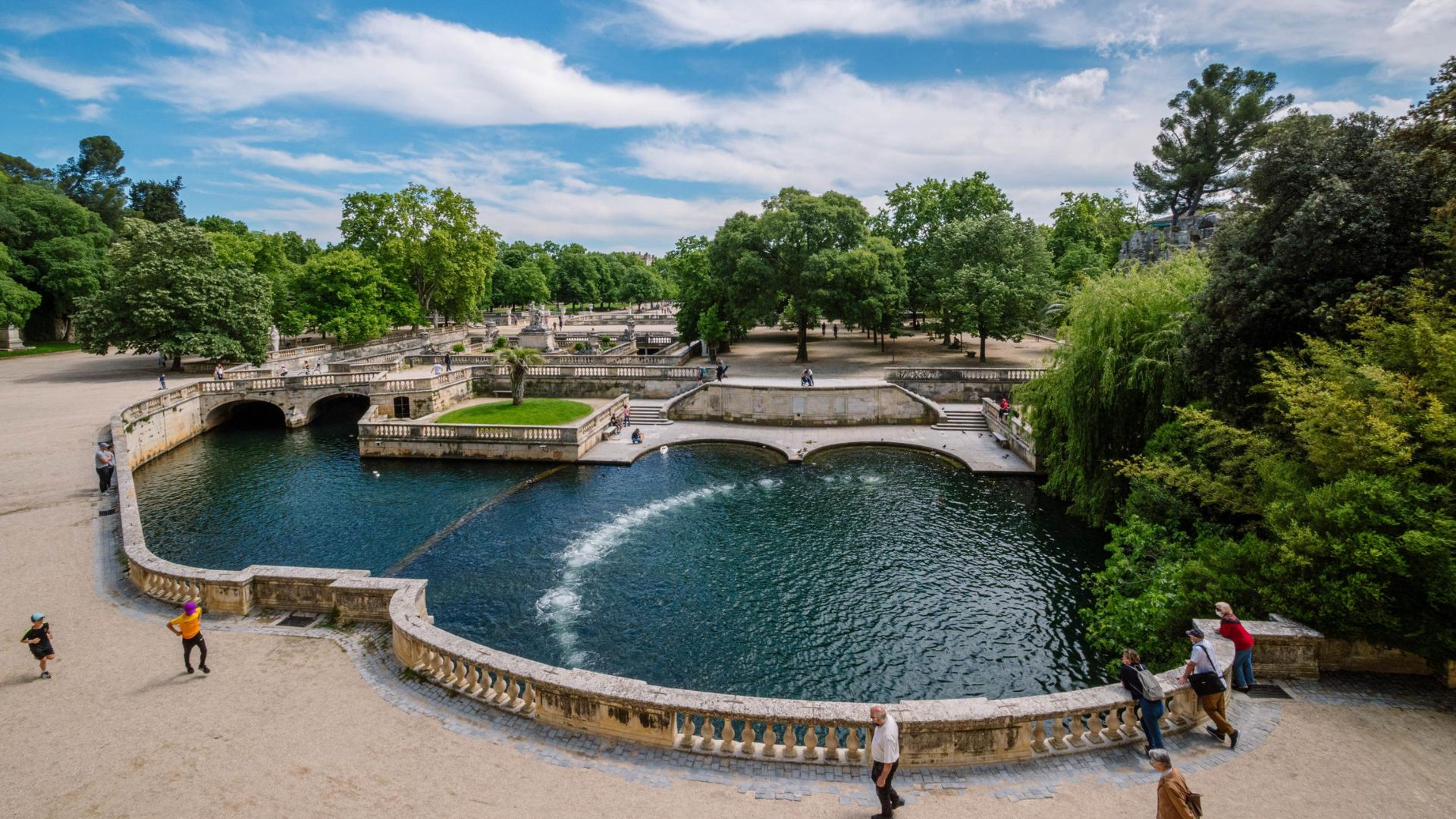 The Jardins de la Fontaine were laid out in the 18th century around the ancient sacred spring of Nemausus, the water source that gave Nîmes its importance during the Roman period. The garden walk through the formal terraces and canal-lined promenades leading up from the city centre is one of the most pleasant sections of this entire route, and the temperature drops noticeably as you move into the tree cover on the upper slopes.
At the centre of the gardens, the ruins of the Temple of Diana sit largely intact despite centuries of stone robbing and later use as a church and medieval fortification. The carved interior vaulting and the deep niches along the nave walls give a strong impression of what the original building felt like, even in its ruined state. The site remains free to enter and is rarely crowded even during peak summer.
- Photo spots: The canal axis looking back toward the city from the lower garden gives a formal symmetrical composition. The Temple of Diana interior in mid-afternoon light produces strong contrast between the carved stonework and the open sky above the collapsed sections.
- Nearby: Several benches along the upper garden terraces are ideal for a rest before the final climb.
- Walking time to next stop: 15 to 20 minutes uphill through the gardens.
Stop 5: Tour Magne and Mont Cavalier
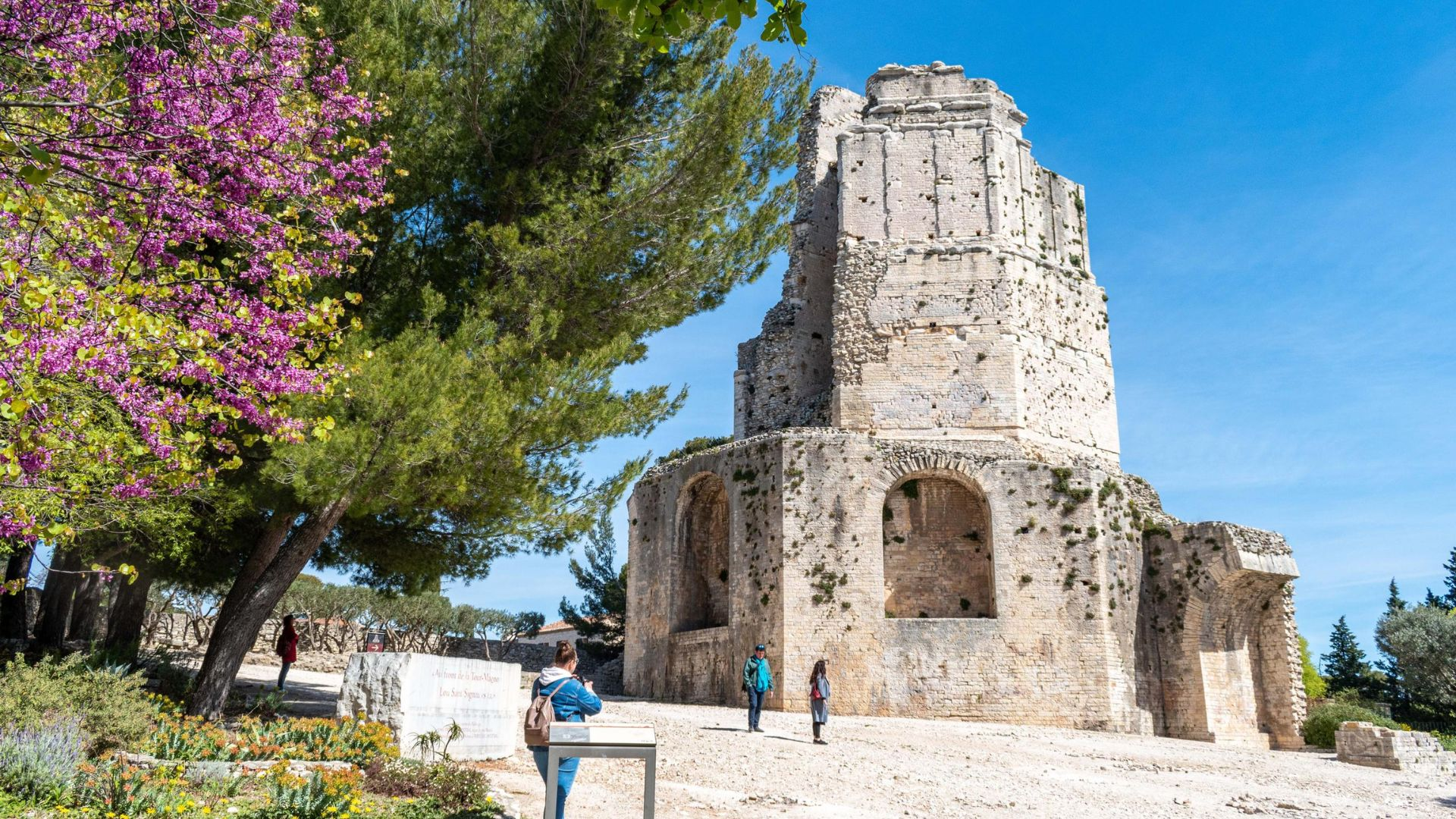 Tour Magne sits at the highest point of Mont Cavalier above the gardens and marks the northwestern corner of the original Roman city wall. The tower is the oldest Roman monument in Nîmes, predating even the arena by several decades, and its original purpose remains debated by historians. Climbing the interior staircase brings you to a roof terrace with a panoramic view across the city, the Garrigues scrubland beyond, and on clear days a long view south toward the Camargue.
This is the physical high point of the walking guide to Nîmes route, and the view from the top gives you an aerial understanding of the city’s layout that makes everything you have already seen on the ground connect more clearly.
Entry: Included in the Nîmes Pass or around €4 independently.
Bonus Extension: Pont du Gard
The Pont du Gard aqueduct sits 25 kilometres northeast of Nîmes and is comfortably reachable by car or organised tour as a half-day extension. The three-tier Roman aqueduct bridge stands 49 metres high and spans the Gardon River in a state of preservation that makes it the most visually spectacular Roman engineering work in France. If you have a car available, leaving Nîmes by early afternoon and spending two hours at the Pont du Gard before returning for dinner is a very natural extension of the day.
Hidden Gems and Local Favourites Along the Route
The covered Les Halles market on Rue des Halles operates Tuesday through Sunday mornings and is one of the finest indoor food markets in the Languedoc region. Local producers bring olives, cheeses, charcuterie, and seasonal produce from the surrounding Gard countryside, and the stalls running along the back wall stock some of the most serious olive oil available in the south of France.
Rue de la Madeleine, running off Place du Forum toward the east, contains several independent boutiques selling locally produced ceramics, printed linens, and Nîmois souvenirs that bear no resemblance to the standard tourist shop output. The small boulangerie at the corner of Rue de la Madeleine and Rue Fresque opens early and produces fougasse that is worth arriving before 9am to find still warm.
Place aux Herbes, just north of the cathedral, is the hidden square that most walking guides miss entirely. It functions as a neighbourhood gathering point rather than a tourist destination, with a weekly antiques and bric-a-brac market on Sunday mornings that draws local collectors and browsers rather than tour groups.
Where to Eat and Drink After Your Walk
Brandade de Nîmes is the dish to order in any traditional brasserie here. It is a salt cod and olive oil preparation specific to the city, served warm as a starter or main course, and it appears on most menus in the historic centre.
Le Ciel de Nîmes, the rooftop café above the Carré d’Art contemporary museum opposite the Maison Carrée, offers good simple food and an exceptional terrace view back toward the Roman temple. It is the most atmospheric lunch stop on the route, and the view alone justifies the stop.
Le Vintage on Boulevard de la République runs a short, well-chosen wine list focused on Languedoc and southern Rhône producers alongside a straightforward evening menu that changes weekly. It is a reliable option for dinner after a full day on the route.
Practical Tips and Variations
Family-friendly version: Cut the Tour Magne climb and replace it with extended time in the Jardins de la Fontaine, where children have considerably more space to move around. The arena holds children’s interest well and the museum within it is accessible and well-presented.
Photography-focused version: Start the route at 7am to reach the arena and Maison Carrée in the first light before any crowds arrive. Both monuments face east or south and catch excellent morning light. Save the Jardins de la Fontaine for late afternoon when the warm light filters through the trees into the formal canal sections.
Accessibility notes: The Maison Carrée and arena both have step access that limits wheelchair and pushchair movement at specific points. The Jardins de la Fontaine lower section is accessible, but the climb to Tour Magne is not suitable for wheelchairs.
Combining with Pont du Gard: A car makes the combination straightforward. Drive to Pont du Gard first thing in the morning when light and crowd levels are both at their best, spend two hours there, return to Nîmes for lunch, and complete the walking guide to Nîmes route through the afternoon.
Frequently Asked Questions (FAQs)
How long does it take to walk historic Nîmes?
The core route covering the arena, Maison Carrée, Place du Forum, Jardins de la Fontaine, and Tour Magne takes between four and five hours at a comfortable pace with proper time at each site. Adding the Pont du Gard extension turns it into a full day. A two hour walk covering just the arena and Maison Carrée is perfectly viable if time is limited, and it gives you the two most significant monuments without rushing the detail.
Is Nîmes worth visiting compared to Arles?
Both cities have strong Roman heritage, but historic Nîmes holds its monuments in a better state of overall preservation. The Nîmes arena is more complete than Arles, and the Maison Carrée has no direct equivalent in Arles. Arles has a stronger claim to Van Gogh heritage and a more atmospheric old town character in some respects. For Roman sites specifically, Nîmes is the stronger destination. If your itinerary allows both, they complement each other well and sit only 30 kilometres apart.
Do I need tickets for the Roman sites?
The arena and Tour Magne both require paid entry. The Maison Carrée interior charges a small entry fee for the projection theatre, though the exterior is fully visible without payment. The Jardins de la Fontaine are free at all times. The Nîmes Pass covering all three paid sites represents the best value for visitors planning to cover the full route.
What is the best time for a walking tour in Nîmes?
Early morning between 8am and 10am gives you the coolest temperatures and the lowest crowd levels at every stop on the route. Arriving at the arena when it opens at 9am means you have the interior largely to yourself before the first tour groups arrive around 10am. Late afternoon from around 4pm onward is the second-best window, particularly for the Jardins de la Fontaine where the light through the plane trees is at its warmest in the hour before sunset.
Wrapping Up…
Nîmes rewards the visitors who come prepared to walk slowly and look closely. This walking guide to Nîmes covers the full range of what the city offers, from the most dramatic Roman monuments in France to the quiet medieval streets and garden terraces that most visitors never find. Give it a full day rather than a rushed morning, use the Nîmes Pass to keep costs manageable, and leave time for the Pont du Gard if your schedule allows. Historic Nîmes is one of the genuinely great cities of Roman Europe, and it remains one of the most undervisited for a destination of that calibre.